
Rethinking Africa’s Basic Education in the Age of AI
The real promise of AI in African education lies not in replacing existing models, but in enabling systems to implement what learning science has long recommended.

A familiar story is often told about education in Africa: too few teachers, overcrowded classrooms, thin resources, and millions of children passing through school without mastering basic literacy and numeracy. Into this long-standing crisis arrives a new actor—artificial intelligence—accompanied by promises of transformation, disruption, and even leapfrogging.
Yet the most important question is not whether AI will change education. It is how it should.
The risk is that policymakers mistake novelty for progress—importing tools designed elsewhere, or imagining that technology can substitute for the slow, cumulative work of learning. The opportunity, by contrast, lies in using AI to reinforce what already works, while adapting schooling to the realities of the digital age.
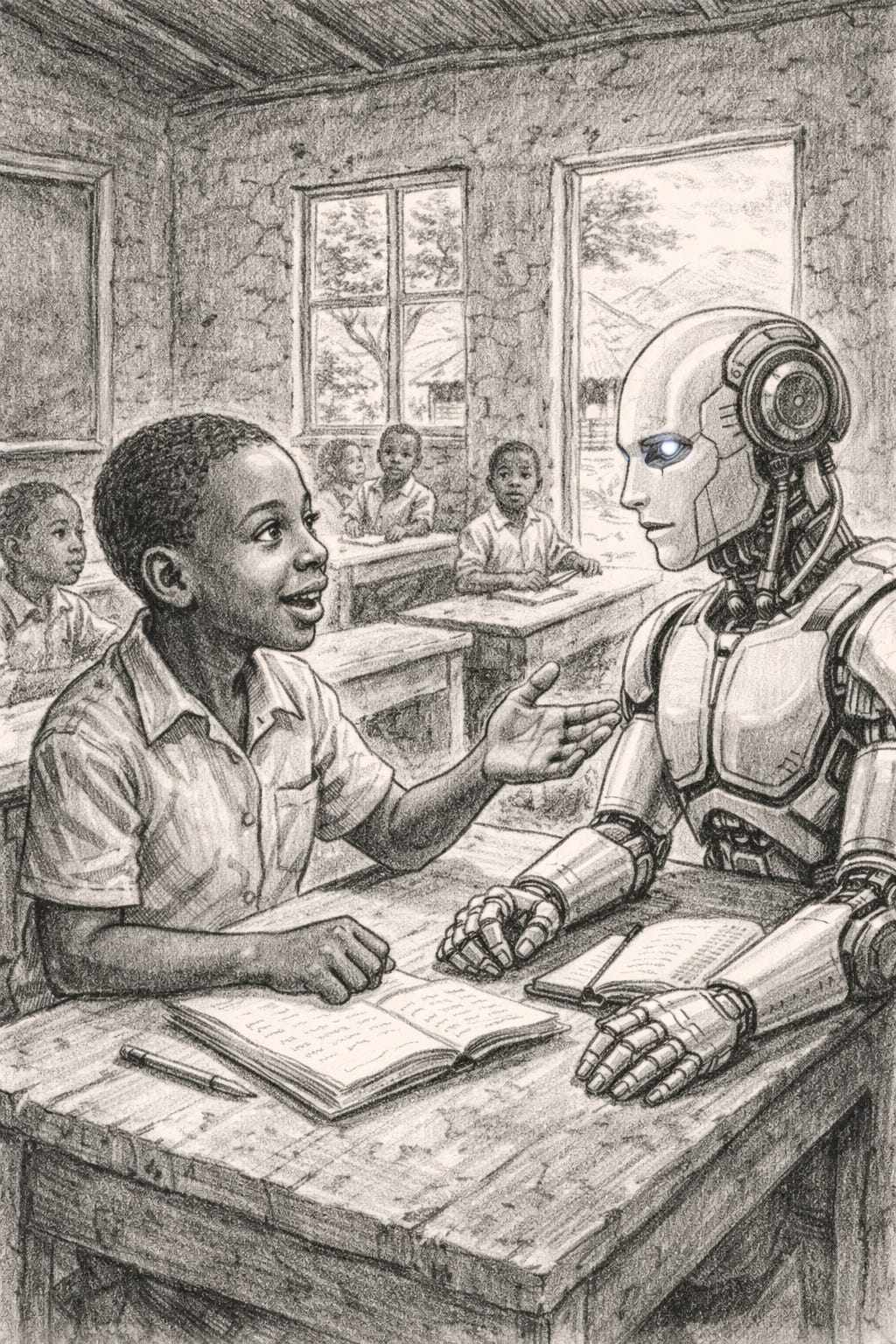
From Scarcity to Precision
For decades, Africa’s education systems have operated under conditions of scarcity: too little instructional time, too few trained teachers, and too limited feedback on whether children are actually learning. In such an environment, teaching is often uniform, regardless of whether pupils understand the material.
Artificial intelligence introduces a different possibility—not abundance in the abstract, but precision in practice.
Recent evidence from Africa suggests this shift is already underway. In a World Bank-supported programme in Edo State, Nigeria, secondary school students using structured, guided interactions with ChatGPT demonstrated learning gains of roughly 0.3 standard deviations in just six weeks—equivalent to up to two years of typical progress in comparable settings. Crucially, these gains were not produced solely by the AI tool, but by its integration into a structured learning environment with teacher support and curriculum alignment.
Similarly, in Kenya, the adaptive learning platform EIDU, combined with structured pedagogy, has shown statistically significant improvements in foundational literacy and numeracy among early-grade learners. Independent evaluations suggest effect sizes of 0.4 standard deviations, indicating meaningful learning acceleration when technology is embedded in classroom practice.
These cases point to a consistent pattern: AI does not replace systems. It sharpens them.
Learning Science, Rediscovered
The real promise of AI in African education lies not in replacing existing models, but in enabling systems to implement what learning science has long recommended.
Research has consistently shown that children learn best when instruction is matched to their level, when feedback is immediate, and when knowledge is reinforced through repetition and retrieval. Yet in practice, these principles are difficult to operationalise at scale.
AI can help close that gap.
UNESCO’s recent work on foundational learning in Sub-Saharan Africa explicitly argues that generative AI should be used to strengthen proven approaches such as Structured Pedagogy and Teaching at the Right Level (TaRL)—both of which depend on continuous assessment and adaptive instruction. AI systems, by tracking learner progress in real time, can support precisely these functions: diagnosing gaps, adjusting content, and ensuring that learners do not advance without mastery.
In this sense, AI does not introduce a new theory of learning. It makes an existing one practically scalable.
The Centrality of the Teacher
If AI strengthens certain aspects of instruction, it also raises a more contentious question: what becomes of the teacher?
In some quarters, the prospect of “teacherless learning” has been advanced as both a technological and economic solution. Yet this view misunderstands the nature of education.
Even in the most promising AI-supported programmes, teachers remain central. In the Nigerian case, educators played an active role in guiding students, structuring interactions with AI, and helping them critically assess responses—particularly to identify errors or hallucinations. Without this layer of human judgment, the gains would likely not have materialised.
Global evidence reinforces this point. High-dosage tutoring—one of the most effective educational interventions—relies not only on content delivery, but on motivation, feedback, and relational support. AI may approximate some elements of tutoring, but it does not replicate the full human function.
The more realistic trajectory is not the disappearance of teachers, but their transformation—from deliverers of content to orchestrators of learning.
Language, Context, and Relevance
Africa’s educational challenge is not only quantitative but linguistic and cultural. Classrooms are often multilingual, and instruction frequently occurs in languages that learners do not fully understand.
Here, too, AI presents both an opportunity and a risk.
UNESCO highlights that learning outcomes improve when early instruction takes place in a language familiar to the learner, supported by aligned materials and teacher training. AI systems, if properly localized, can assist in translation, content adaptation, and multilingual instruction.
But most existing models are trained on predominantly Western datasets. Without deliberate localization, they risk reinforcing linguistic exclusion rather than alleviating it.
If AI is to support learning in Africa, it must be built or adapted for African contexts—not merely deployed within them.
The Infrastructure Constraint—and Opportunity
Much of the global conversation around AI in education assumes reliable electricity, high-speed internet, and widespread device access. These assumptions do not hold uniformly across Africa.
Yet innovation is already adapting to this reality.
In Zimbabwe, for example, a government-supported initiative has deployed an AI-enabled educational chatbot via WhatsApp, allowing learners to access curriculum-aligned content, past papers, and revision materials through low-bandwidth mobile channels. This reflects a broader pattern: in Africa, the most scalable applications of AI in education may not be high-end platforms, but lightweight, mobile-first solutions.
The lesson is straightforward. Technology must fit the infrastructure—not the other way around.
Rethinking the School Day
If AI can reduce the time required for routine practice and feedback, it raises a deeper question: how should the rest of the school day be used?
One possibility is to accelerate academic progression. Another is to rebalance schooling toward activities that are less easily automated: collaboration, creativity, problem-solving, and practical skills.
The latter appears more aligned with the direction of technological change.
As machines become more capable of handling routine cognitive tasks, the comparative advantage of human learners shifts toward judgment, originality, and social intelligence. Schools, in turn, may need to evolve from sites of content delivery to environments for capability development.
Policy Without Illusion
For policymakers, the challenge is to navigate between two extremes.
The first is technological scepticism—treating AI as a distraction. The second is technological determinism—assuming it will solve systemic problems unaided.
Neither is sufficient.
Encouragingly, some African countries are beginning to take a more grounded approach. Tanzania’s national guidelines on AI in education, for instance, emphasise ethical use, teacher capacity, data protection, and equitable access—signalling a shift toward governance frameworks that match technological ambition with institutional responsibility.
The task now is to move from policy to practice:
integrating AI into curriculum and assessment systems,
training teachers to use and supervise AI tools,
ensuring accessibility across linguistic and socio-economic divides,
and establishing safeguards around data and algorithmic bias.
A Different Kind of Reform
Africa’s education systems have long been shaped by constraints—of resources, capacity, and scale. Artificial intelligence does not remove those constraints. But it changes how they can be managed.
The most valuable contribution of AI may not be to revolutionise education overnight, but to enable systems to do something more modest and more important: to teach better, more consistently, and more responsively than before.
The evidence so far—from Nigeria’s AI-assisted tutoring experiments, to Kenya’s adaptive learning platforms, to Zimbabwe’s mobile-based solutions—suggests that this is already possible.
The question, then, is not whether Africa will adopt AI in education. It is whether it will do so in a way that is anchored in learning science, grounded in local realities, and guided by a clear institutional purpose.
Because in the end, the future of education will not be determined by algorithms.
It will be determined by how they are used.