

For much of the past three years, the economics of artificial intelligence have rested on a simple assumption: frontier laboratories would continue producing the world’s most capable models, and customers would pay a premium for access. Investors have financed billions of dollars in computing infrastructure on the belief that superior intelligence would remain scarce.
That assumption is now being tested.
The debate over “open versus closed” AI is often framed as a philosophical argument. It is, in fact, an economic one. Open-weight models do not need to outperform frontier models to reshape the industry. They merely need to become good enough for most commercial applications.
History suggests that technological advantages rarely remain exclusive for long. Computing power, cloud infrastructure, and software all became cheaper and more accessible over time. Artificial intelligence appears to be following the same trajectory.
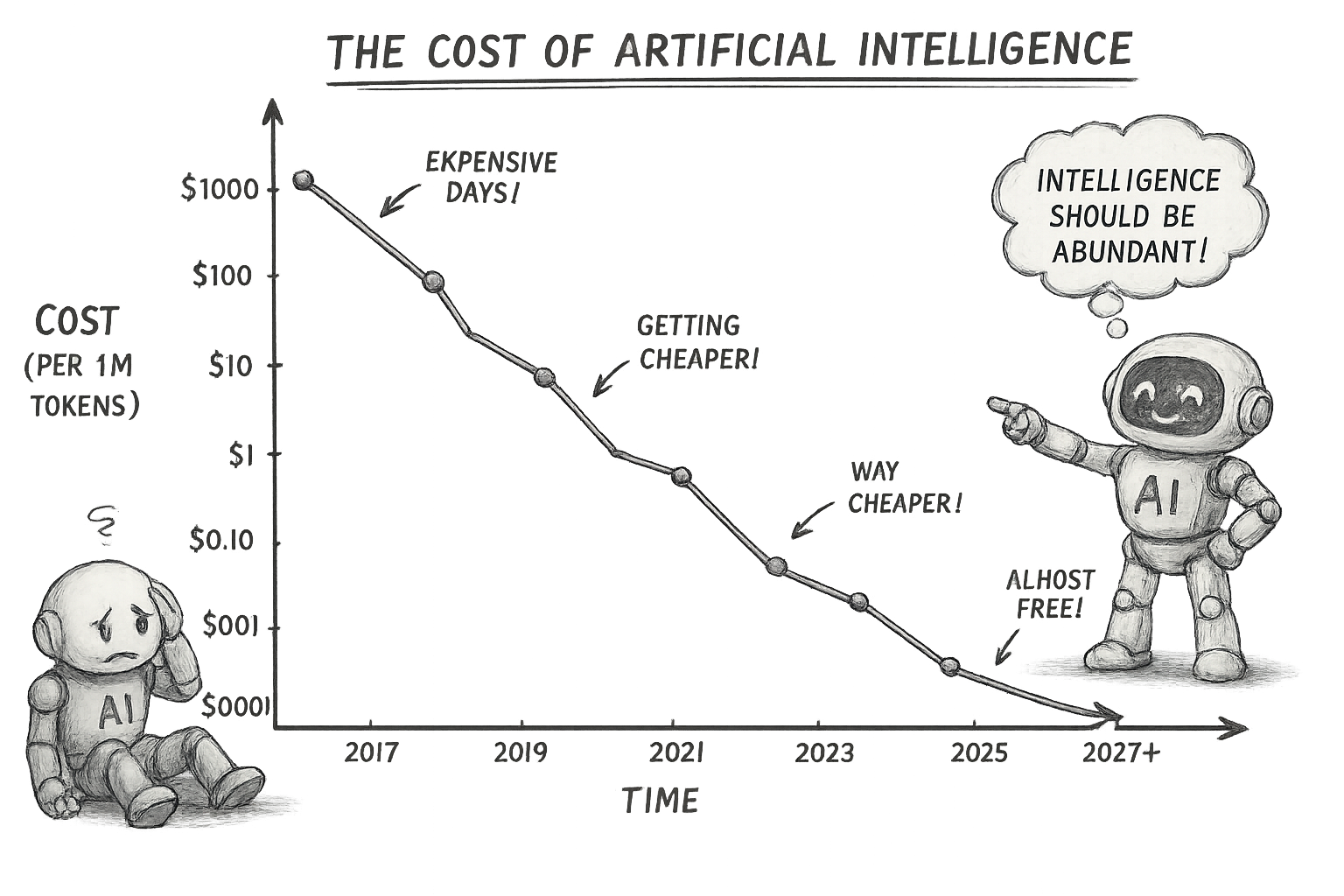
The Race to Commodity Intelligence
The cost of using AI continues to fall as hardware improves, models become more efficient, and competition intensifies. As inference becomes cheaper, intelligence itself risks becoming a commodity.
In commodity markets, value rarely resides in the underlying technology alone. It shifts towards customer relationships, integration, proprietary data, and specialized applications.
For frontier laboratories, this presents a dilemma. Building the most capable model may no longer guarantee the highest returns if competing models deliver similar performance at substantially lower cost.
Open Weights Change the Rules
Open-weight models are accelerating this shift.
By allowing organizations to download, modify, and run models on their own infrastructure, they reduce dependence on a handful of AI providers. Governments can retain sensitive data within their borders, businesses can customize models for specialized tasks, and developers gain greater freedom to innovate.
Open weights also create competitive pressure. Even companies that continue purchasing proprietary models benefit from having credible alternatives. Pricing power weakens as capable substitutes become more widely available.
Competition increasingly shifts away from owning the smartest model toward building the best ecosystem around it.
The Distillation Dilemma
Perhaps the greatest threat to frontier laboratories is not open weights themselves, but distillation.
Distillation allows smaller models to learn from larger ones by training on their outputs. A frontier laboratory may invest billions developing a cutting-edge model, only for competitors to reproduce much of its commercial value at a fraction of the cost.
The challenge is structural. Frontier laboratories earn revenue by exposing their models through APIs, yet those same APIs provide opportunities for competitors to learn from them.
Legal protections offer only partial solutions. Copyright protects specific expressions rather than model behavior. Trade-secret law protects confidential methods, not necessarily outputs deliberately shared with customers. Contracts may prohibit systematic extraction, but enforcing them across jurisdictions remains difficult.
Distillation therefore compresses the commercial lifespan of frontier advantage. The question becomes not whether competitors will catch up, but how quickly.
Will Governments Protect Frontier Labs?
As artificial intelligence becomes strategically important, governments may feel pressure to intervene.
Support is unlikely to take the form of shielding companies from competition. Instead, governments may strengthen protections against large-scale model extraction, invest in national AI infrastructure, tighten export controls or provide incentives for domestic AI development.
Yet policymakers face a difficult balance. Protecting frontier laboratories too aggressively could reduce competition, keep AI expensive and slow innovation. Doing too little risks allowing strategic technologies to diffuse too rapidly.
The debate over AI safety is therefore also a debate over industrial policy and economic competitiveness.
From Model Moats to Platform Moats
The assumption that superior models alone create durable competitive advantages is increasingly questionable.
Knowledge spreads. Researchers move between firms. Techniques are published. Open-weight models improve rapidly. Distillation accelerates diffusion.
The strongest competitive advantages may instead lie in areas that are harder to replicate: enterprise relationships, trusted brands, proprietary datasets, agent platforms, compliance capabilities and deep integration into customer workflows.
The model becomes only one component of a much larger system.
What This Means for Africa
For Africa, these changes could represent an opportunity rather than a threat.
Historically, the continent has adopted major digital technologies after they were developed elsewhere. Frontier AI appeared likely to follow the same pattern, with access controlled through expensive proprietary services.
Open-weight models change that equation.
African governments, universities and businesses can adapt existing models for local languages, agriculture, education, healthcare and financial services without bearing the enormous cost of developing frontier models from scratch.
This is particularly important because commercial incentives alone are unlikely to prioritize many African languages or local challenges. Open weights allow local institutions to build solutions that global providers may overlook.
They also strengthen digital sovereignty. Governments handling sensitive public data can increasingly deploy AI within national or regional infrastructure rather than relying exclusively on foreign providers.
However, open models are not a complete solution. Successful adoption still requires reliable electricity, affordable computing infrastructure, skilled engineers, and supportive regulation. Without investment in these foundations, Africa risks remaining dependent on imported infrastructure even if the software itself becomes open.
Rather than competing directly with frontier laboratories, African countries may gain more by investing in AI talent, regional data centers, open datasets and practical applications that address local economic needs.
The democratization of AI offers Africa an opportunity to become not merely a consumer of artificial intelligence but an active creator of solutions tailored to emerging markets.
The New Economics of Intelligence
The AI industry is likely to evolve into three distinct layers.
A small number of frontier laboratories will continue pushing the boundaries of capability.
Open-weight communities will rapidly diffuse many of those advances.
Application companies will create value by combining increasingly interchangeable models with proprietary data, specialized workflows, and customer relationships.
The greatest profits may ultimately belong not to those producing intelligence, but to those applying it most effectively.
The Race Against Commoditization
The defining challenge facing frontier laboratories is no longer simply building the world’s smartest models.
It is remaining commercially valuable as intelligence becomes cheaper, more accessible and increasingly difficult to monopolize.
Open-weight models, falling inference costs and distillation are reshaping the economics of artificial intelligence. Frontier laboratories are unlikely to disappear, but they may increasingly compete on platforms, ecosystems and services rather than model superiority alone.
For Africa, this transition presents a rare strategic opportunity. If governments and businesses invest in digital infrastructure, talent and locally relevant applications, the continent could benefit disproportionately from the falling cost of intelligence.
The future of AI may therefore be defined less by who invents intelligence than by who can deploy it most effectively. In a world where intelligence becomes abundant, competitive advantage will belong not to those who own the model, but to those who build the most valuable systems around it.